 Raisedash
A CDL Driver Identified 1 of 4 Road Signs. Three People Died. We Built a Free Tool With 1,094 Signs to Practice.
When a California truck driver failed a roadside sign recognition test, identifying just 1 of 4 signs, it followed a crash that killed 3 people. With 8,200+ federal inspections now targeting sign knowledge and English proficiency, we built a free road signs practice tool with 1,094 signs, flashcards, 7,400+ quiz questions, and progress tracking.

A Driver Identified 1 of 4 Road Signs. Three People Died. Here's a Free Tool With 1,094 Signs to Practice.
In August 2025, a truck driver with a California-issued CDL made an illegal U-turn on the Florida Turnpike. His trailer jackknifed across traffic. Three people were killed. When Florida investigators ran a post-crash English proficiency assessment, the driver correctly answered just 2 of 12 questions. He identified only 1 of 4 road signs. He still had a valid commercial driver's license.
That crash changed everything. It became one of the catalysts for the most aggressive federal enforcement campaign the trucking industry has seen in a decade.
The Federal Government Is Now Testing Sign Knowledge at the Roadside
If you haven't been following the enforcement news closely, here's the short version. On February 20, 2026, Transportation Secretary Sean Duffy announced sweeping changes to CDL testing including a nationwide English-only requirement for all CDL exams. Before this, California alone offered the CDL test in 20 different languages. A driver could pass the test in Mandarin in California, then drive through all 50 states without ever demonstrating they could read a single English road sign.
That loophole is now closed. But the testing change is only half the story.
The enforcement half is where most drivers should be paying attention. Under Operation SafeDRIVE, federal inspectors have conducted 8,200+ inspections and removed 704 drivers from service. Roughly 500 of those drivers were cited specifically for failing English proficiency standards. By December 2025, nearly 9,500 commercial truck drivers had been removed from service after failing English proficiency checks nationwide.
Part of every roadside ELP assessment is a highway traffic sign recognition test. The officer produces a chart of standard signs and asks you to explain what each one means. In English. No translation apps. No interpreters. No cue cards. The FMCSA guidance is explicit about that.
Fail the sign recognition portion, and you're placed out of service on the spot. Your truck doesn't move until a qualified replacement driver arrives. The violation stays on your Pre-Employment Screening Program (PSP) record for 3 years.
The Problem Isn't Just Language. It's That Nobody Studies Signs After Getting Their CDL.
Here's something that doesn't get talked about enough. The sign recognition problem isn't limited to non-native English speakers.
Think about it. When did you last study road signs? For most drivers, the answer is the day before their CDL written exam. That was years ago, maybe a decade ago. You passed, got your license, and never looked at a sign chart again.
But the MUTCD (Manual on Uniform Traffic Control Devices) contains over a thousand signs. Some are obvious. Everyone knows what a stop sign means. But how many drivers can explain the difference between a yellow diamond sign with a truck on a hill and a yellow diamond sign with a truck on a curve? Can you describe what a blue rectangular sign with an "H" means versus a green rectangular sign with an "H"? What does a pennant-shaped sign mean, and where is it placed?
Construction zone signs alone cover 32 different variations. Guide signs have 254. You encounter them on every trip. And if you're honest with yourself, you probably drive past a dozen signs every day that you couldn't precisely define if someone put you on the spot.
Now picture a DOT officer holding up a chart of those signs and asking you to explain them. That's the test. And it's happening right now, at scales and weigh stations across the country.
We Built Road Signs to Close This Gap
Road Signs is a free practice tool with every road sign a CDL driver can encounter on US roads. Not a sample. Not a "top 50." 1,094 signs in the library, organized across 6 categories, with flashcard study mode, 7,400+ practice questions, and 600+ preset tests you can take on your phone.
We built it because we kept hearing the same thing from drivers and fleet managers: there's no good way to study road signs after the initial CDL exam. The DMV doesn't offer a practice tool. The FMCSA doesn't provide one. Most drivers resort to googling "road signs quiz" and clicking on some random website with 20 signs and pop-up ads.
That's not preparation. That's guessing.
Every Sign, Organized So You Can Actually Learn Them
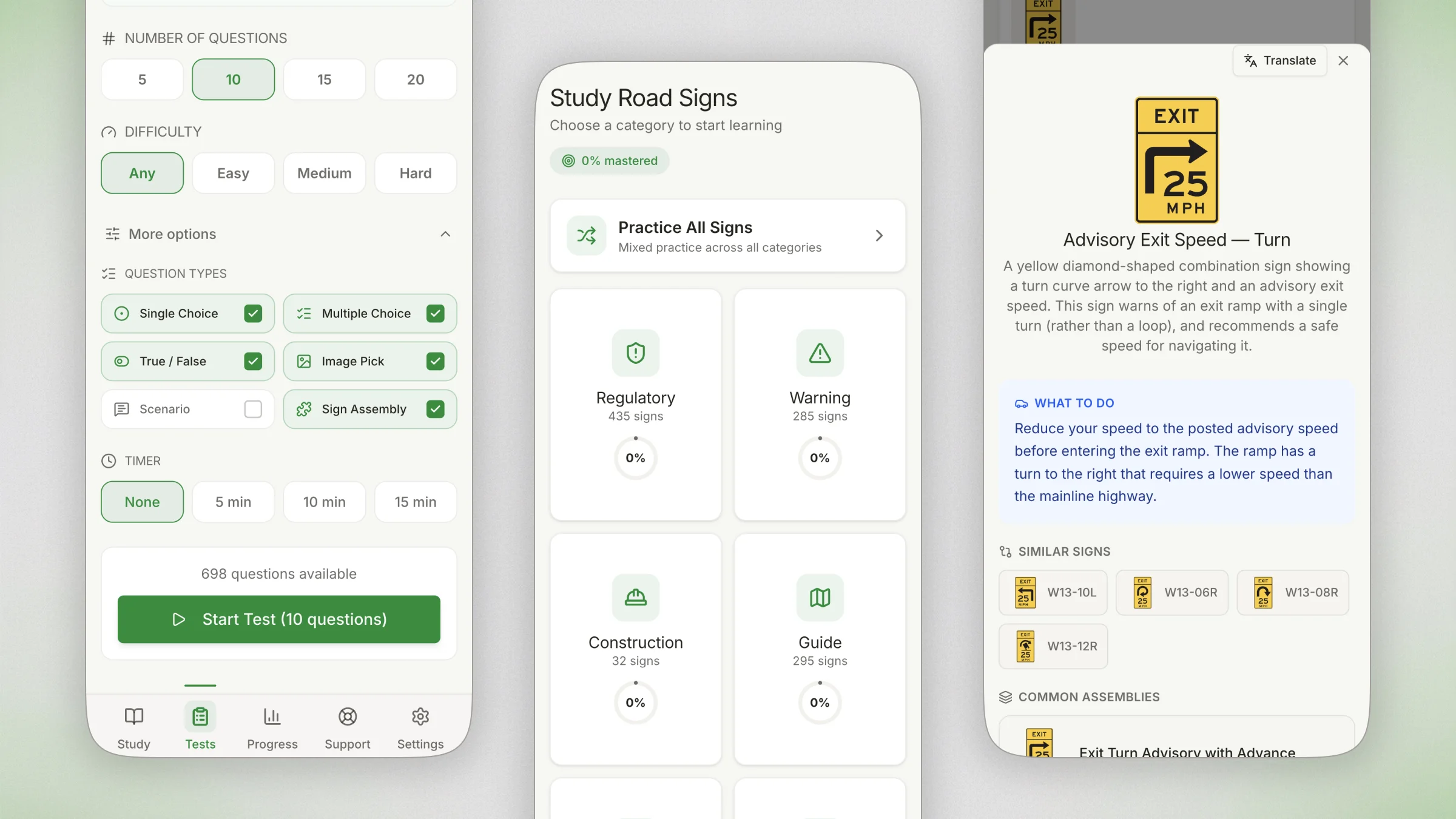
The signs are organized into 6 categories that match how the MUTCD classifies them:
Regulatory signs (418 signs) cover speed limits, lane usage, turn restrictions, parking rules, and everything else that tells you what you must or must not do. These are the signs that carry legal weight. Missing one of these isn't just a knowledge gap. It's a moving violation waiting to happen.
Warning signs (249 signs) alert you to road conditions, curves, intersections, and hazards ahead. Construction zone approaches, merge points, low clearance, and school zones all fall here.
Construction signs (32 signs) are the orange ones. They control traffic through work zones. They change constantly depending on the construction phase, and getting them wrong in an active work zone puts lives at risk.
Guide signs (254 signs) are the green and blue signs that provide route information, distances, services, and destinations. These seem simple until a DOT officer asks you to explain what a specific blue service sign means.
Hazmat signs (5 signs) are specific to commercial drivers. You need to recognize hazmat placards, class labels, and route restriction signs. This is tested separately in hazmat endorsement exams, but it shows up in general CDL inspections too.
Service signs (42 signs) point to gas, food, lodging, hospitals, and other amenities. They're less likely to show up in a roadside assessment, but they round out the full MUTCD catalog.
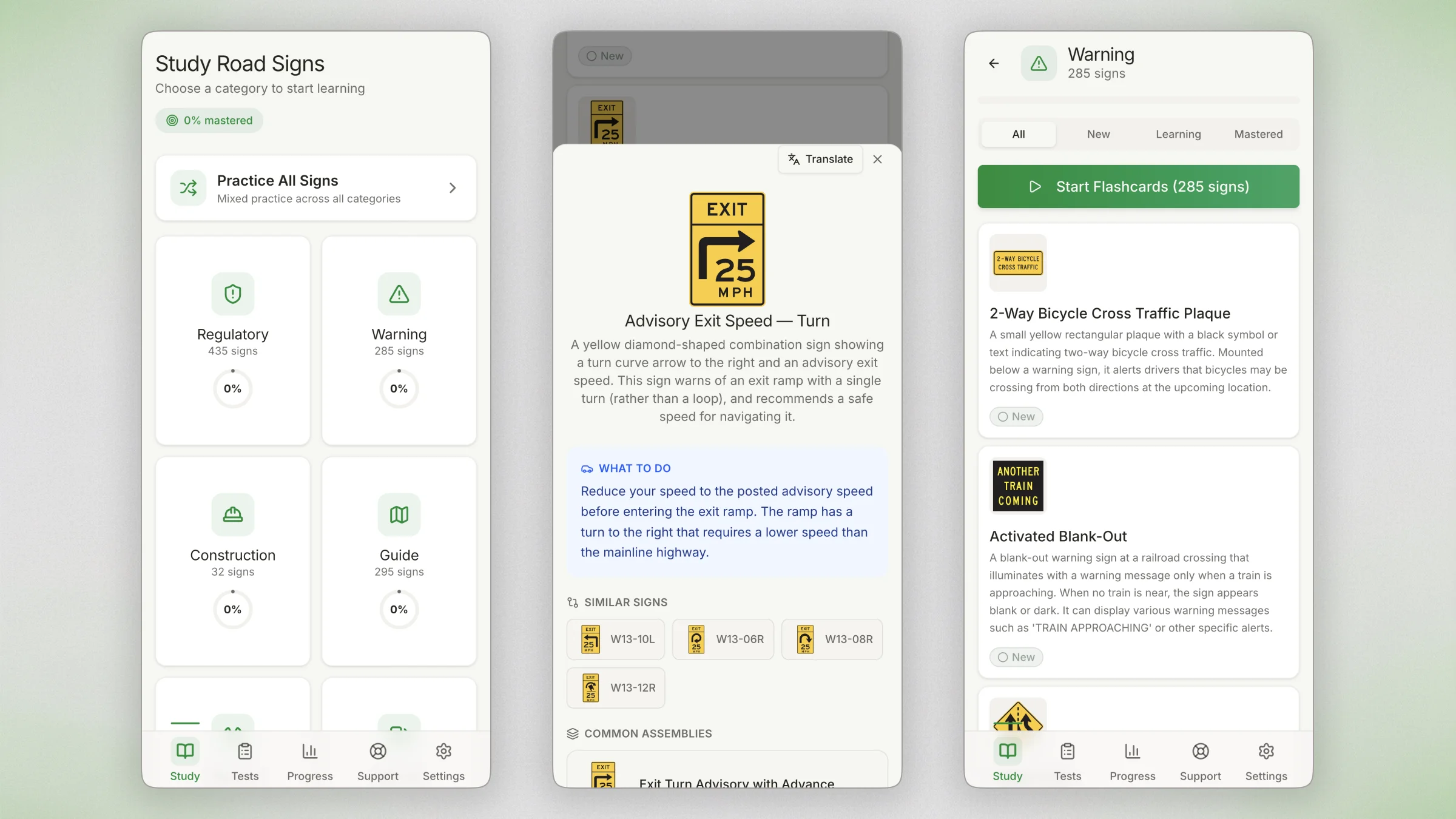
Each sign includes a clear description of what it means, a "What to Do" section explaining the exact driver action required, and a fun fact for context. You're not just memorizing shapes and colors. You're learning why each sign exists and what happens if you ignore it.
Two Ways to Learn: Flashcards and Practice Tests
We didn't want to build a tool that only works one way. Some drivers learn best by flipping through cards at their own pace. Others need the pressure of a timed quiz. Road Signs supports both.
Flashcard Study Mode
Pick a category. Start flipping. The front of each card shows the sign image. Tap to flip and you see the sign name, its full meaning, what action to take, and a contextual fact. After each card, you mark "Knew It" or "Didn't Know." The app tracks your mastery level for every single sign: New, Learning, Familiar, or Mastered.
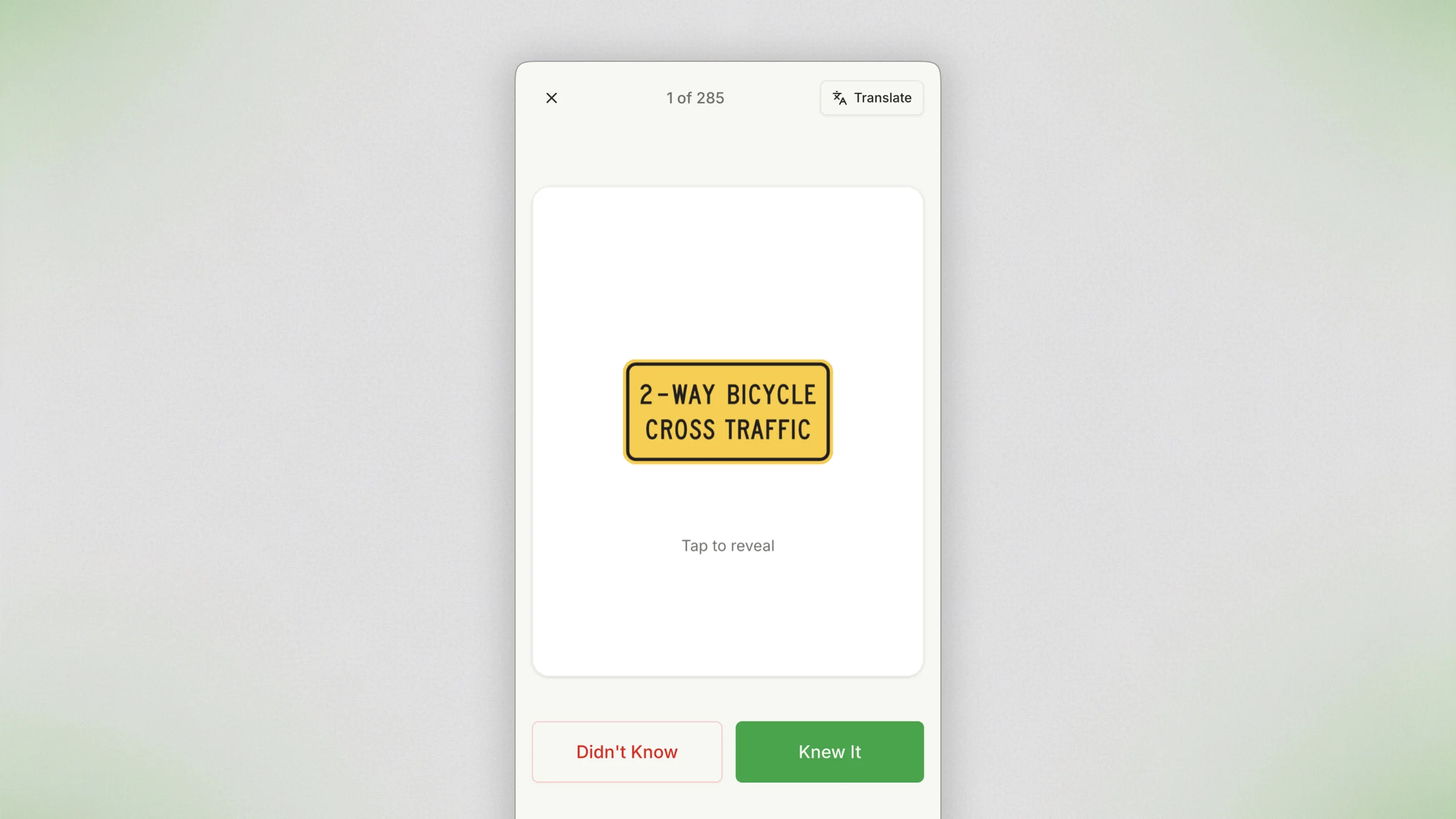
You can filter by mastery level to focus your study time where it matters. If you have 15 minutes at a truck stop, filter to "Learning" signs and drill the ones you're weakest on. The mastery system remembers where you left off. A sign needs at least 3 views and 80% accuracy before it's marked as "Mastered."
There's also a "Practice All Signs" mode that shuffles every sign across all categories. Good for a comprehensive review before an inspection or CDL renewal.
Practice Tests (600+ Preset, Plus Custom)
This is where it gets serious. Road Signs includes over 600 preset tests organized by category and difficulty. Each test gives you a passing score, a time limit (if applicable), and a question count before you start. You'll know exactly what you're getting into.
But the real power is the Custom Test Builder. You pick the categories you want to test. Set the question count (5, 10, 15, or 20). Choose the difficulty (easy, medium, hard, or mixed). Select which question types to include. Set a timer if you want the pressure. The app tells you how many questions are available matching your criteria before you start, so you're never guessing.
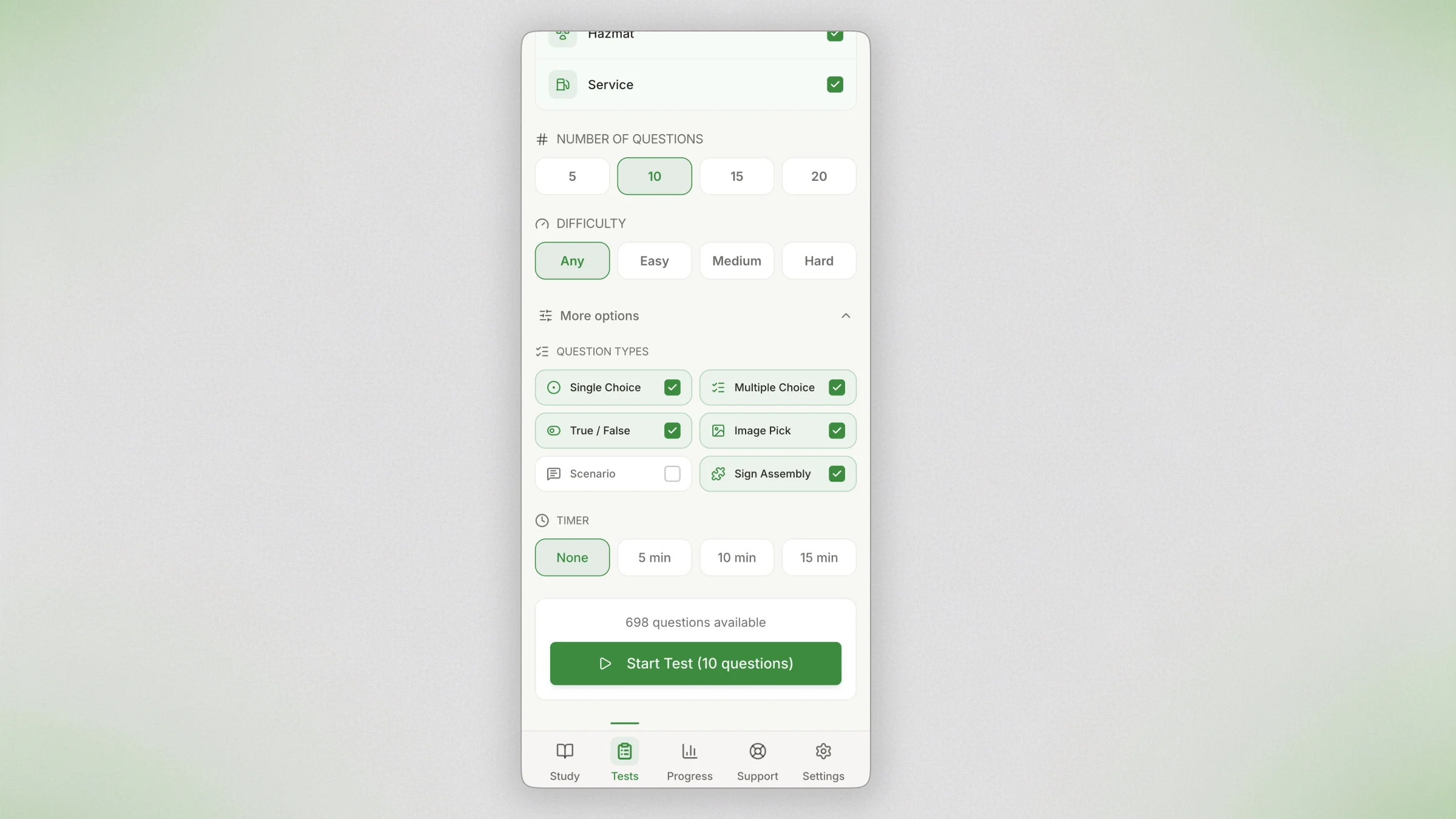
There's also a "Weak Areas" preset that automatically builds a test from signs you've gotten wrong most often. That single feature probably saves more study time than anything else in the tool.
Six Question Types That Go Beyond Multiple Choice
Most road signs quizzes give you a sign and four text options. That only tests recognition in one direction. Real-world sign knowledge means you can identify a sign when you see it, recall what it means from a description, recognize it among similar signs, and understand how it applies in context.
Road Signs uses 6 different question formats to test all of those:
Single choice gives you a sign image and 4 possible meanings. The classic format. Good for quick identification.
Select all that apply shows you a sign and asks you to pick every correct statement about it. Harder than it sounds. Partial answers don't count.
True or false is fast and direct. "This sign means no U-turn." True or false? You tap, the app tells you instantly.
Image pick flips the script. It gives you a text description and shows you 4 sign images. Pick the right one. This tests whether you can connect a verbal description to the visual sign, which is exactly what happens when a DOT officer describes a scenario and asks which sign applies.
Scenarios add real-world context. "You're approaching a construction zone on I-40. You see this sign. What should you do?" These test applied knowledge, not rote memorization.
Sign assembly shows you a combination of signs stacked on a single pole, the way you'd actually see them on the road. A speed limit sign above a "School Zone" placard means something different than that speed limit sign by itself. This format tests whether you understand how signs interact with each other.
After every question, you get immediate feedback. Correct or wrong, the app shows you the full explanation. No waiting until the end of the test to find out you've been wrong about "No Passing Zone" signs for the last 200 miles.
Progress Tracking That Shows You Where You Stand
The dashboard gives you a clear picture of where you stand across every sign in the library. An overall mastery percentage ring shows your total progress. Below that, each category has its own mastery breakdown.
Stat cards track your day streak, overall accuracy, total signs learned, and tests passed. Your last 5 tests show up with their scores and pass/fail status. And a "Signs to Review" section highlights your 5 weakest signs with their individual accuracy percentages, so you always know where to focus next.
For fleet managers, this kind of visibility matters. When a DOT auditor asks how you're training drivers on sign recognition, "they studied on their own" isn't an answer. Documented progress across specific sign categories, with accuracy data per driver, is an answer.
Built-In Translation for Non-Native English Speakers
Road signs on US highways are in English. The DOT expects you to understand them in English. But studying them in English when English is your second language is a real barrier.
Road Signs includes an on-demand translation feature that supports 10 languages: Spanish, Chinese, Arabic, Hindi, French, Russian, Portuguese, Turkish, Korean, and Uzbek. During any flashcard session or test, you can tap the translate button to see the sign's meaning in your native language. The English stays visible alongside the translation, so you're learning the English term while understanding the concept in your first language.
This isn't a crutch. It's a bridge. The goal is for drivers to eventually understand every sign in English without the translation. But starting from zero without any native-language support means most non-native speakers give up after two sessions. Translation keeps them in the app long enough to actually learn.
If you're a driver working on your English proficiency more broadly, TruckTalk covers the spoken English side: vocabulary, conversations, and AI voice roleplay for DOT inspections. Road Signs handles the visual recognition piece. Together, they cover both halves of what the FMCSA ELP assessment actually tests.
Free to Start. Regulatory and Warning Signs Cost Nothing.
You don't need a credit card to start. Sign in with Google and you get immediate access to the Regulatory and Warning sign categories. That's 667 signs for free. The two categories most likely to appear in a roadside assessment, completely open, no paywall.
For drivers who want the complete library (all 6 categories, 1,094 signs, plus unlimited tests), premium plans start at $8.97 per month on the annual plan. Quarterly runs $14.97 per month. Monthly is $19.97.
For fleets and trucking schools, enterprise plans start at $147 per month for up to 25 drivers and scale down to $1.79 per driver per month at the fleet tier. Drivers join through a company invite code. No individual payment needed on the driver's end. You can pair Road Signs with Raisedash Shift for a complete DOT compliance training pipeline that covers pre-trip inspections, DVIRs, road signs, and English proficiency all in one platform.
The Enforcement Isn't Slowing Down
Let's be clear about where things stand. The DOT shut down 7,000 "CDL mills" (schools that were caught lacking proper curriculum, using unqualified instructors, and in some cases feeding answers through Bluetooth earpieces). More than 550 additional schools received removal notices in February 2026 after 1,400 investigations. States that don't enforce English proficiency standards lose federal funding. California lost $40 million and may have lost up to $200 million total for non-compliance.
The Dalilah Law, introduced in Congress, would require every CDL holder in the country to recertify within 180 days, including English proficiency and sign recognition verification. Whether or not it passes in its current form, the direction is clear: more testing, more inspections, higher standards.
A driver who can't identify road signs is a safety risk. The federal government has decided to treat it that way. The fines, the out-of-service orders, the 3-year PSP marks, and the CSA score damage are all designed to make sure drivers and carriers take sign knowledge seriously.
The good news? You can study 667 signs for free on your phone right now. It takes 5 minutes to start and 10 minutes a day to build the kind of sign knowledge that keeps you on the road when that DOT officer pulls out the chart.
Start practicing road signs for free. No credit card. No commitment. Works on any phone.
Frequently Asked Questions
What road signs does the DOT test during a roadside inspection?
During a roadside ELP assessment, the inspecting officer uses a chart of standard highway traffic signs from the MUTCD (Manual on Uniform Traffic Control Devices) and asks the driver to identify and explain their meanings in English. The assessment typically includes regulatory signs (stop, yield, speed limit, no passing), warning signs (curves, intersections, construction zones), and guide signs. There is no fixed set. The officer picks from the chart, so you need broad sign knowledge, not just the "top 10."
How many road signs are in the Road Signs tool?
Road Signs includes 1,094 signs organized into 6 MUTCD categories: Regulatory (418), Warning (249), Construction (32), Guide (254), Hazmat (5), and Service (42). The library covers the standard US road signs a CDL driver encounters on the road and during inspections.
Is Road Signs free?
Yes. The Regulatory and Warning categories (667 signs total) are completely free with a Google sign-in. These are the two categories most relevant to DOT roadside assessments. Premium unlocks all 6 categories, unlimited test access, and additional features. Plans start at $8.97 per month on the annual plan.
What question types does Road Signs use?
Six formats: single choice, select all that apply, true or false, image pick (match a description to the correct sign image), scenarios (applied real-world context), and sign assembly (multiple signs stacked together as they appear on actual road poles). This variety tests recognition, recall, and applied understanding, not just rote memorization.
Does Road Signs support languages other than English?
Yes. An on-demand translation feature supports 10 languages: Spanish, Chinese, Arabic, Hindi, French, Russian, Portuguese, Turkish, Korean, and Uzbek. During study and test sessions, you can translate any sign's meaning into your native language while the English text stays visible. The goal is to build English sign comprehension, not bypass it.
How is this different from TruckTalk?
TruckTalk focuses on spoken English proficiency: vocabulary, conversations, quizzes, and AI voice roleplay for DOT inspections. Road Signs focuses specifically on visual sign recognition and knowledge. A DOT roadside ELP assessment tests both. TruckTalk prepares you for the verbal interview portion. Road Signs prepares you for the sign identification portion. They work together to cover the full assessment.
Can fleet managers use Road Signs for driver training?
Yes. Enterprise plans support up to 500+ drivers. Each driver joins through a company invite code, no individual payment required. The progress dashboard tracks mastery levels, test scores, and sign knowledge gaps per driver. Pricing starts at $147 per month for up to 25 drivers and goes as low as $1.79 per driver per month at the fleet tier.