 Raisedash
600+ Drivers Already Pulled Off the Road for Failing English. Here's How to Not Be Next.
FMCSA's English proficiency crackdown is here. California alone pulled 600+ truckers off the road in January 2026. We built TruckTalk, a free CDL English practice tool with AI voice roleplay, so drivers can prepare before their next DOT inspection.

600+ Drivers Pulled Off the Road for Failing English. Here's How to Prepare Before Your Next Inspection.
A CHP officer pulls a commercial truck driver over in California. Routine inspection. He asks a few questions in English. The driver tells him he "only understands a little English." The officer pulls out a chart of traffic signs and asks the driver to identify them. The driver can't. He fails on the spot. His truck doesn't move until someone else takes the wheel.
That scene, captured on camera by KRON4, is playing out hundreds of times across the state right now. And it's not just California anymore.
The Federal Crackdown Is Not a Rumor. It's Happening.
On February 20, 2026, Transportation Secretary Sean Duffy stood at DOT headquarters and announced sweeping changes to CDL testing. The headline: all CDL exams must now be administered exclusively in English. No exceptions. California had been offering them in 20 different languages.
But the testing change is just one piece. The enforcement push started months earlier.
In May 2025, the CVSA (Commercial Vehicle Safety Alliance) voted to add English Language Proficiency failures to its Out-of-Service criteria. That took effect June 25, 2025. Every state in the country started enforcing it. Every state except one.
California refused. Governor Newsom's CHP said enforcing ELP as an out-of-service violation was "not part of California law."
The federal response was blunt. USDOT withheld $40,685,225 in Motor Carrier Safety Assistance Program funding from California. Secretary Duffy put it plainly: "I put states on notice this summer. Enforce the Trump Administration's English language requirements or the checks stop coming."
California caved. On January 1, 2026, CHP began enforcing ELP requirements at roadside inspections.
The numbers since then tell the story. In January 2026 alone, California-based inspectors issued more than 400 ELP violations, a 300% increase over the 2025 monthly average. More than 600 drivers have been pulled off the road. California went from dead last in enforcement to 15th nationwide in total ELP out-of-service violations in a single month.
Operation SafeDRIVE, the federal enforcement campaign, has conducted 8,200+ inspections and removed 704 drivers from service. Roughly 500 of those drivers were cited specifically for failing English proficiency standards.
This isn't going away. Congress passed the Consolidated Appropriations Act of 2026 in February, which includes a provision requiring FMCSA to update regulations so that English proficiency failure triggers an out-of-service order. It's becoming codified federal law. And the Dalilah Law, introduced just days ago, would require every CDL holder in the country to recertify within 180 days, including English proficiency verification.
What the Roadside ELP Assessment Actually Looks Like
Most drivers have heard vague things about the English requirement. Few know what the actual assessment involves. Here's exactly what happens.
Under 49 CFR § 391.11(b)(2), every CDL holder must be able to "read and speak the English language sufficiently to converse with the general public, to understand highway traffic signs and signals in the English language, to respond to official inquiries, and to make entries on reports and records."
At a roadside inspection, the assessment has two parts.
Part one is a driver interview. The inspector asks questions about your trip, your vehicle, your duty status, and your load. You need to answer in English. Not with a translation app. Not through an interpreter. The FMCSA guidance is explicit: interpreters, I-Speak cards, cue cards, smartphone translation apps, and phone interpretation services are not allowed during the assessment. They mask a driver's inability to communicate.
Part two is a highway traffic sign recognition test. The officer produces a chart of standard traffic signs and asks you to identify what each one means. You need to explain them in English.
Fail either part, and you're placed out of service immediately. Your truck doesn't move until a qualified replacement driver arrives. The violation goes on your inspection history through the Pre-Employment Screening Program (PSP), where it stays for 3 years. Future employers see it when they run your background.
For carriers, the consequences compound. Federal civil penalties for ELP violations can reach five figures per occurrence under 49 CFR Part 386. Add the cost of a stranded truck, a delayed load, and a replacement driver, and a single failed ELP check can cost thousands. ELP violations also go into the driver's PSP record and can damage your fleet's CSA scores, affecting your insurance rates and ability to win contracts.
Why Generic English Apps Won't Prepare You
Here's what most drivers do when they hear about the English requirement. They download Duolingo. Or Babbel. Or some other general English learning app.
Those apps teach you to order coffee. They teach you to ask where the bathroom is. They teach you basic greetings and travel vocabulary.
None of that helps when a DOT officer asks you to explain your ELD logs, describe your duty status for the past 24 hours, or read a Bill of Lading and identify the hazmat classifications on your load.
The English that truck drivers need is specialized. It's ELD terminology. Shipping paper vocabulary. Pre-trip inspection language. Hours of service rules explained in English. Dispatch communication. Weigh station procedures.
A driver who scores B2 on a general English test can still freeze when an officer asks "Can you walk me through your log for today?" because they've never practiced that specific vocabulary in that specific context.
That's the gap we built TruckTalk to close.
We Built TruckTalk for Exactly This Moment
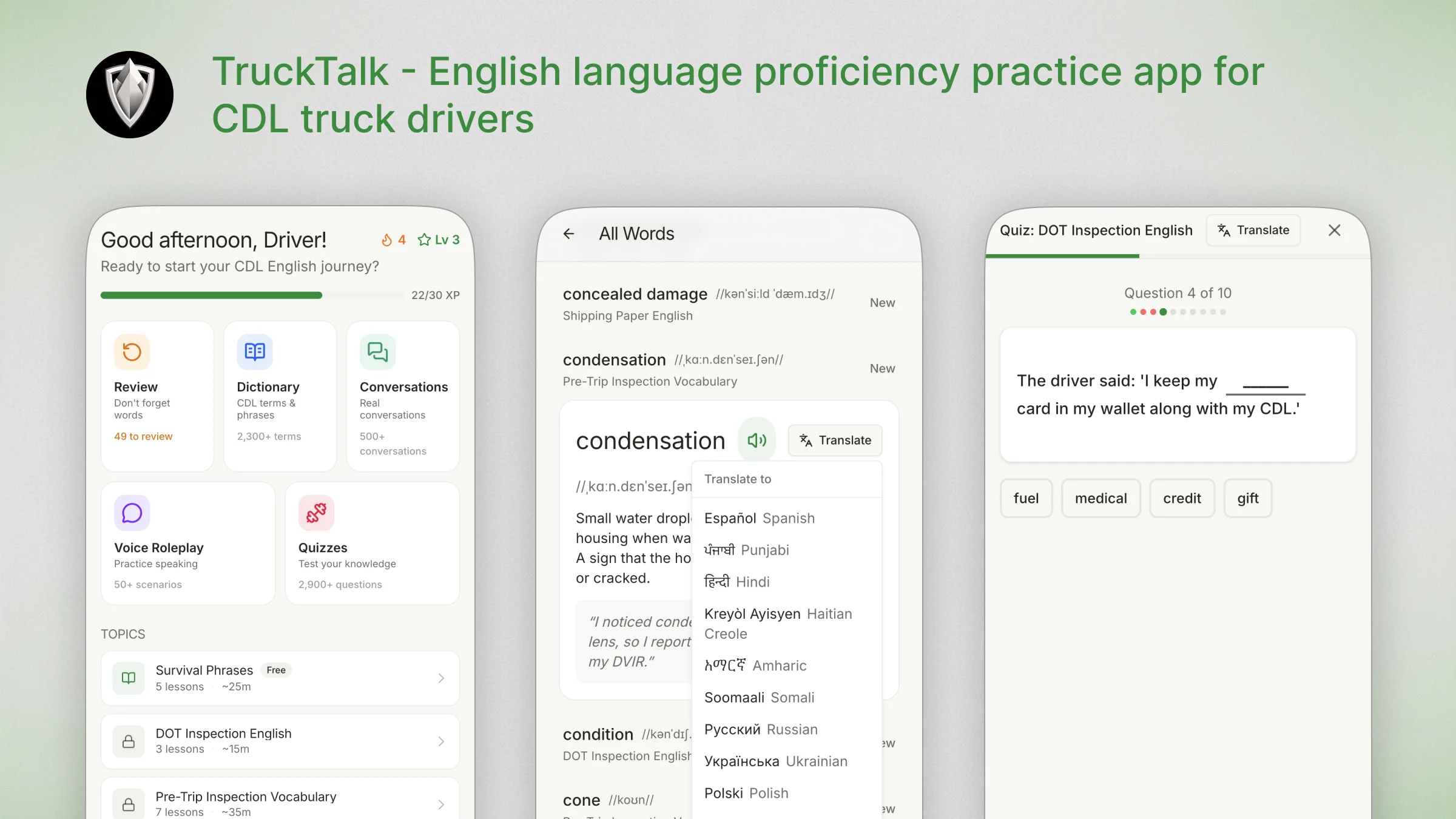
TruckTalk is an English Language Proficiency practice tool built specifically for CDL truck drivers. Not generic English learners. Not tourists. Not business professionals. Truck drivers who need to pass a DOT roadside inspection.
Every single word, phrase, conversation, and quiz question inside the app is specific to trucking. There is not one lesson about ordering coffee.
Here's what's inside.
2,300+ Trucking-Specific Vocabulary Terms
The dictionary covers every term a driver might encounter during an inspection, at a dock, on a shipping paper, or in an ELD log. Each term includes a clear definition, a phonetic pronunciation guide, an example sentence showing how it's used, and native audio so you hear exactly how it sounds.
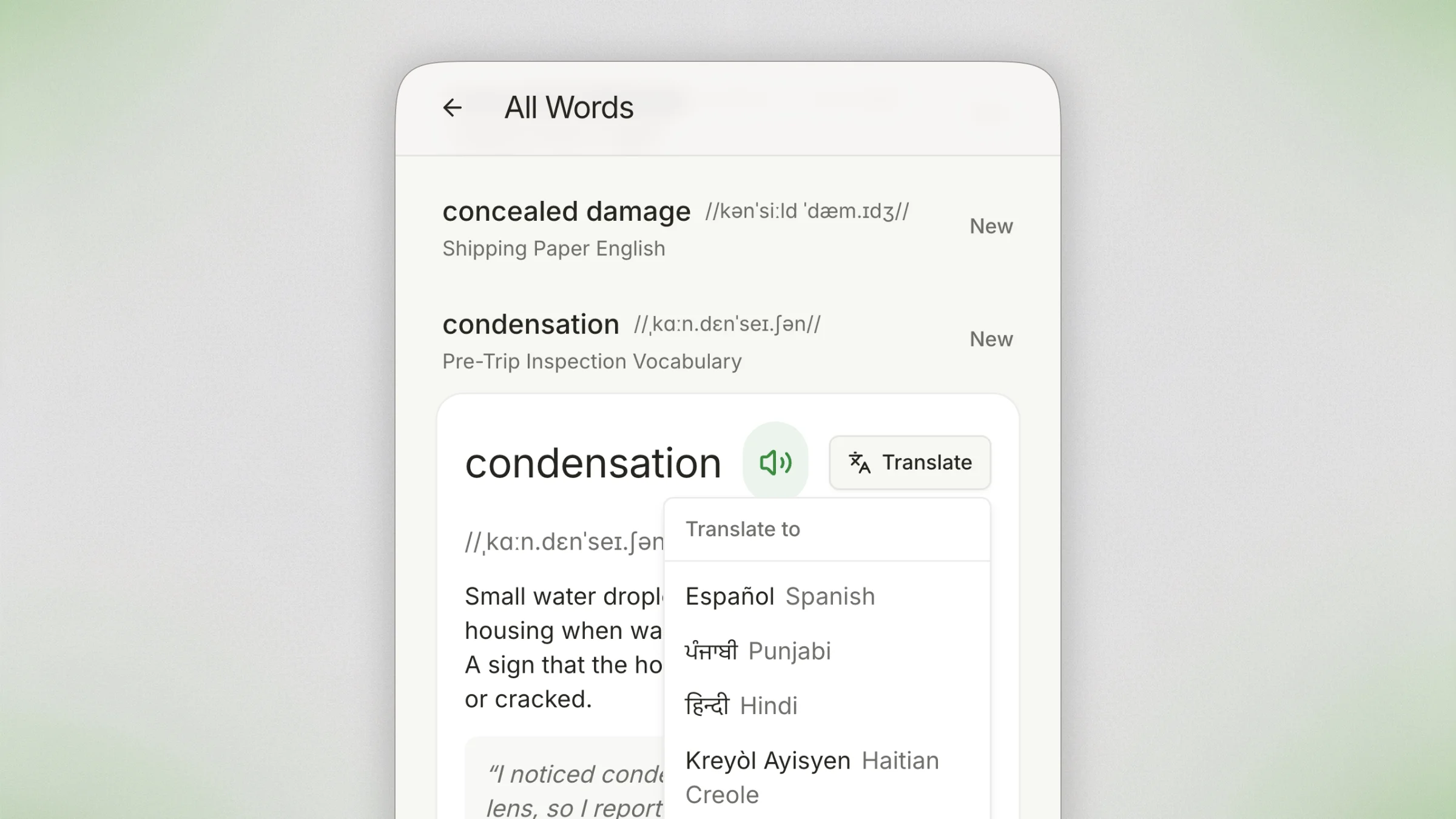
The translate button lets you see any definition or example in your native language. TruckTalk supports 11 native languages: Spanish, Punjabi, Hindi, Haitian Creole, Amharic, Somali, Russian, Ukrainian, Polish, French, and Uzbek. These aren't random choices. They represent the primary languages spoken by non-native English-speaking CDL holders in the United States.
500+ Example Conversations
Pre-written conversations between drivers and DOT officers, dispatchers, shippers, receivers, and mechanics. Each conversation is organized by topic: Survival Phrases, DOT Inspection English, Pre-Trip Inspection Vocabulary, Shipping Paper English, Logbook and HOS Talk.
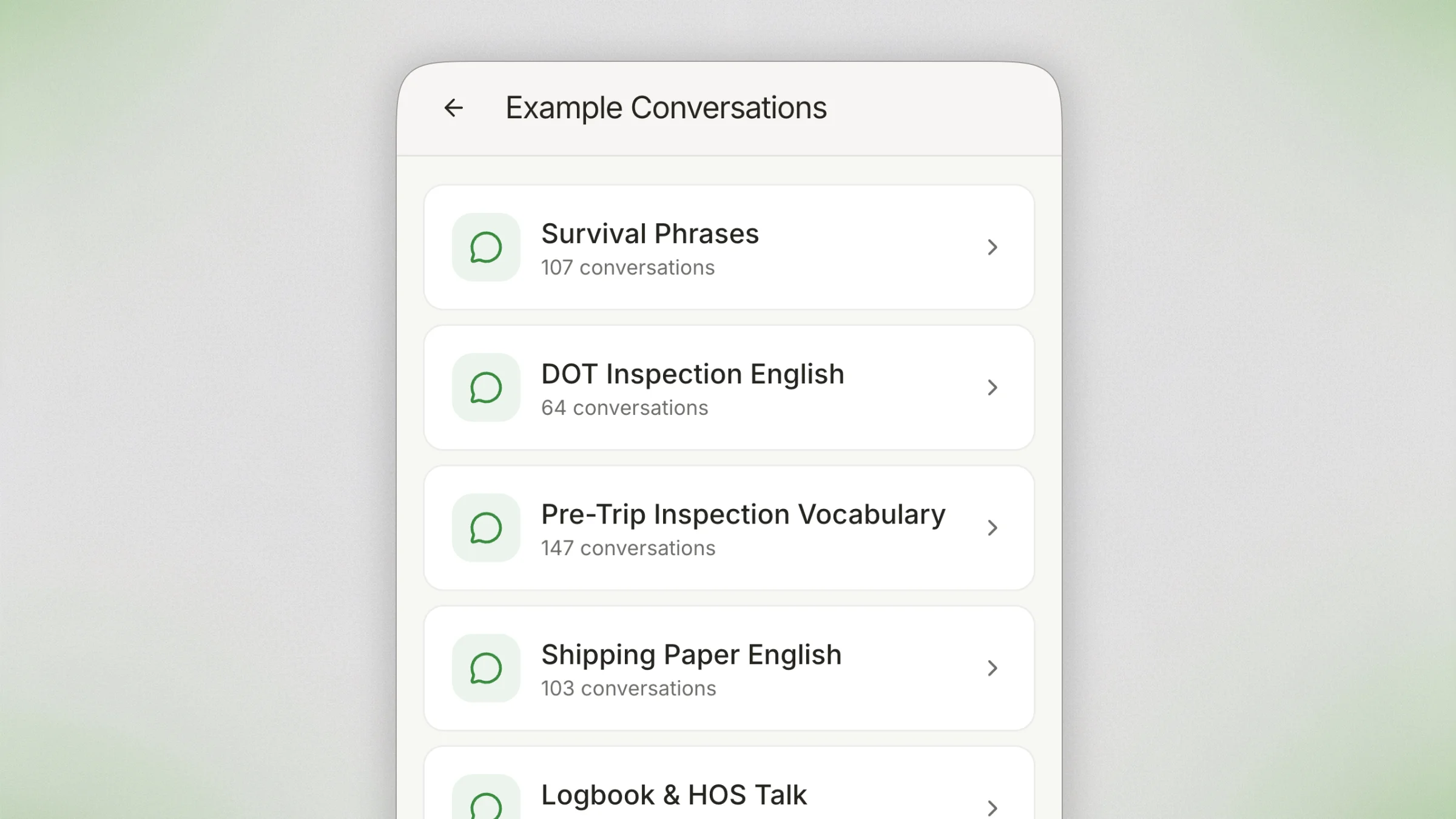
Every line has audio playback. You read the conversation, listen to how it sounds, and translate any line you don't understand. It's like eavesdropping on 500 real trucking interactions and studying each one.
2,900+ Quiz Questions
Six different exercise types: multiple choice, image matching, fill-in-the-blank, listen-and-choose, read-and-answer, and term matching. The questions test real trucking knowledge, not abstract grammar.
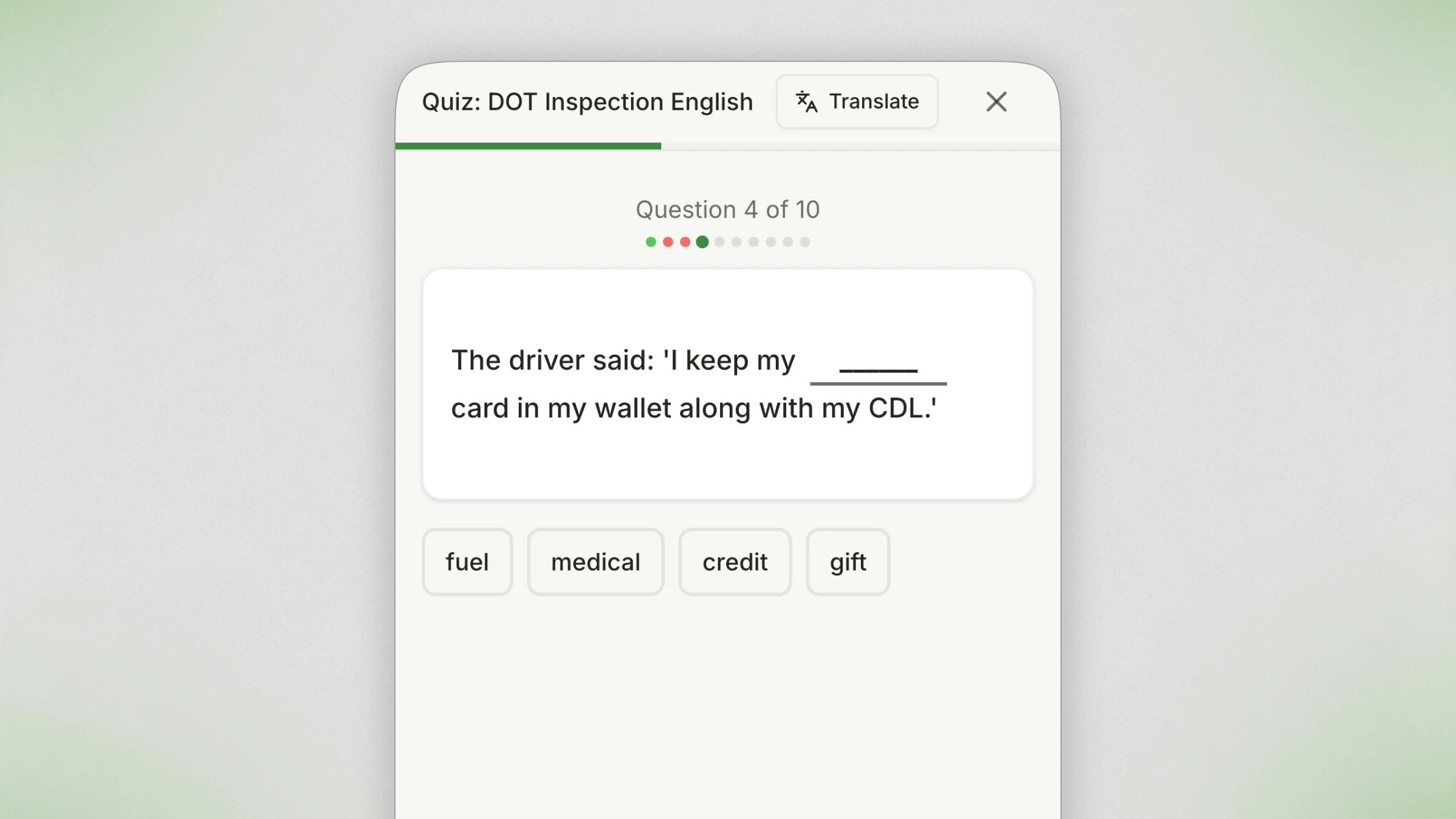
A question might show a sentence like "The driver said: 'I keep my ___ card in my wallet along with my CDL'" and ask you to pick the right word. That's the kind of practical vocabulary a DOT officer expects you to know.
AI Voice Roleplay (The Feature That Changes Everything)
This is what makes TruckTalk different from any flashcard app or vocabulary list.
You open a scenario. An AI-powered DOT officer, dispatcher, or shipper starts talking to you out loud. You answer out loud, in English, using your phone's microphone. The AI responds based on what you said. It's a real conversation, not a scripted playback.
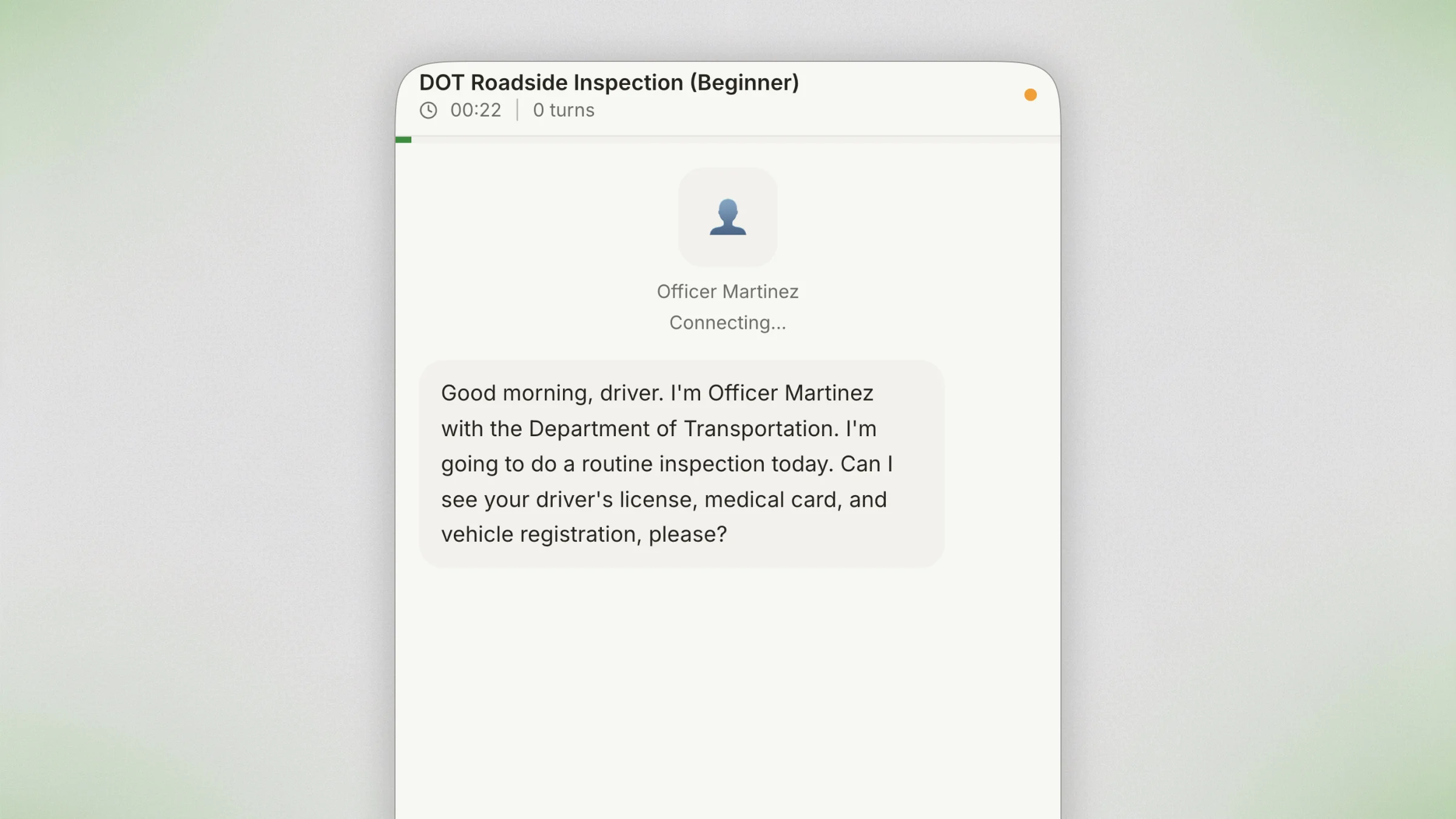
There are 50+ scenarios across three difficulty levels: beginner, medium, and advanced. Beginner scenarios might have a friendly officer asking basic questions about your trip. Advanced scenarios put you in a full DOT inspection where you need to explain your ELD logs, walk through your hours of service, and describe your cargo.
After each session, TruckTalk scores your performance. Not just "pass" or "fail." You get a detailed breakdown: listening comprehension, response clarity, vocabulary range, conversation control, and task completion. You get specific feedback on what you did well, what to improve, and an action plan with practice suggestions. The AI even rewrites your weaker responses to show you exactly how you could have answered better.
Each session runs up to 5 minutes. That's deliberate. You can practice during a break at a truck stop, while waiting at a dock, or in the sleeper before your next shift. Short enough to fit into a driver's day. Focused enough to build real skill.
Interactive Document Training
TruckTalk includes interactive replicas of the documents drivers handle every day. An ELD display with a full 24-hour duty timeline, color-coded by status, where you can tap any segment to learn the English terminology. A Bill of Lading with highlighted fields you can tap to get plain-English explanations. Hazmat shipping papers with UN numbers, proper shipping names, and hazard classes explained in context.
These aren't abstract lessons about documents. They're the actual documents, made interactive so you learn the English by using it.
How It Works (2 Minutes to Start)
You sign up. Pick your native language. Choose your English level (beginner, intermediate, or advanced). That's it. You're on the study page.
Lessons are designed for 5 to 10 minutes each. The daily goal defaults to about 10 minutes of practice. You can adjust that. The app tracks your streak, awards XP for every activity, and promotes you through 12 levels from Student Driver to Hall of Fame. It's designed to build a habit, not just deliver a lesson.
A spaced repetition system tracks every word you study. Words you struggle with come back sooner. Words you know well come back later. Study less, remember more.
Free to Start. No Credit Card.
TruckTalk has a free tier that includes the complete "Survival Phrases" module, 3 AI voice roleplay sessions, 3 quizzes per day, and access to the dictionary. That's enough to get started and see real progress before paying anything.
If you want the full library, premium plans start at $9.99 per month on the annual plan. That's less than a truck stop meal.
For fleet managers and carriers, TruckTalk offers fleet plans starting at $8.99 per seat per month for large fleets. You get a dashboard showing every driver's progress, completion rates, and ELP readiness. When an auditor asks how you verified your drivers' English competency, you have timestamped records showing what each driver studied, practiced, and passed. Pair it with Raisedash Shift for full DOT compliance training and your fleet has documented proof across every training requirement.
The Enforcement Timeline Is Clear
Here's what has already happened and what's coming.
June 25, 2025: CVSA Out-of-Service criteria for ELP violations took effect nationwide.
January 1, 2026: California, the last holdout state, began enforcing ELP at roadside inspections.
February 3, 2026: Congress passed legislation requiring FMCSA to codify ELP out-of-service orders in regulation.
February 20, 2026: Transportation Secretary Duffy ordered English-only CDL testing.
The direction only goes one way. More enforcement. Stricter standards. Bigger consequences. Every month that passes without preparation is a month closer to an inspection you're not ready for.
This Isn't About Politics. It's About Safety.
The debate around English proficiency enforcement has gotten political. We're not here for that conversation.
We're here because a driver who can't read a road sign is a danger to everyone on the highway. A driver who can't explain their duty status during an inspection has a problem that costs them their livelihood. A carrier with drivers who can't pass an ELP check faces fines, out-of-service orders, and compliance risk that threatens their operating authority.
Those are facts. And the solution is straightforward: practice the English you actually need, in the context you'll actually use it, before you're standing on the shoulder of a highway with a DOT officer waiting for an answer.
Start practicing with TruckTalk for free. No credit card. No commitment. Works on any phone. It takes 2 minutes to set up and 5 minutes a day to build the skills that keep your CDL and your career intact.
Frequently Asked Questions
What is the FMCSA English Language Proficiency requirement?
Under 49 CFR § 391.11(b)(2), all CDL holders must be able to read and speak English well enough to converse with the general public, understand highway traffic signs, respond to official inquiries, and make entries on reports and records. This is assessed at roadside inspections without the use of translators or translation devices.
What happens if I fail an ELP check at a DOT inspection?
You're placed out of service immediately. Your truck stays parked until a qualified replacement driver arrives. The violation goes on your inspection history through the FMCSA Pre-Employment Screening Program (PSP) for 3 years, affecting your ability to get hired by future employers. Carriers also face federal civil penalties that can reach five figures per violation.
How is TruckTalk different from Duolingo or other English apps?
Generic English apps teach everyday vocabulary like ordering food or asking for directions. TruckTalk teaches the specific English you need as a CDL driver: ELD log terminology, Bill of Lading vocabulary, DOT inspection questions, dispatch communication, and hazmat shipping paper language. Every word, conversation, and quiz question is built for trucking.
Can I actually practice speaking, not just reading?
Yes. TruckTalk's AI Voice Roleplay feature lets you have real spoken conversations with AI-powered DOT officers, dispatchers, and shippers. You speak out loud in English and get scored on your listening comprehension, response clarity, vocabulary, and task completion. There are 50+ scenarios across three difficulty levels.
What languages does TruckTalk support for translations?
TruckTalk supports 11 native languages for in-app translations: Spanish, Punjabi, Hindi, Haitian Creole, Amharic, Somali, Russian, Ukrainian, Polish, French, and Uzbek. All learning content and definitions can be translated to help you understand new terms in your native language.
Is there a free version?
Yes. The free tier includes the full Survival Phrases module, 3 AI voice roleplay sessions, 3 quizzes per day, and dictionary access. No credit card required.
Does TruckTalk work for fleet managers who need to train multiple drivers?
Yes. Fleet plans include a management dashboard where you can track each driver's progress, quiz scores, and ELP readiness. Pricing starts at $14.99 per seat per month for small fleets and goes as low as $8.99 per seat per month for fleets over 100 drivers. Drivers can be invited by link, email, or code and start learning in under 2 minutes.