 Raisedash
Could you produce one driver's complete training record today? A self-audit checklist
A practical self-audit for fleets: who asks for driver training records, what a complete record actually contains, and a checklist to find your gaps before an auditor, insurer, or attorney does.

Here is a test. Pick one driver you hired eighteen months ago. Now, without calling anyone or opening a filing cabinet, produce a complete record of everything that driver was trained on: the exact version of the material they saw, their quiz scores, their signatures, and the dates. Not just a certificate. The whole record.
If that would take you a week, or if the honest answer is that some of it no longer exists, you are not unusual. You also have a problem that tends to surface at the worst possible moment. This is a self-audit you can run this week, before someone else runs it for you.
Who actually asks for a driver's training record
Three groups ask, and they ask for different reasons and with very different stakes.
FMCSA and safety auditors. A safety review or audit can ask to see what you keep on your drivers. An organized file answers quickly and quietly. A disorganized one turns a routine check into a deeper one and signals that your recordkeeping might not be the only thing that is loose.
Insurers and loss-control partners, usually at renewal. When your fleet comes up for renewal, the people pricing your risk want evidence of a real safety process, not assurances. A fleet that can show consistent, documented onboarding and training tends to have a very different renewal conversation than one that cannot.
Plaintiff attorneys, in discovery after a crash. This is the highest-stakes reader. After a serious crash, the other side will request records and ask precisely what the driver was trained on, in what version, and when they acknowledged it. In an industry where large jury awards are a genuine and constant fear, the completeness of that record is not a clerical detail. It is part of your defense.
The pattern across all three: nobody wants a certificate that says a driver "completed training." They want to see exactly what the driver received, that the driver engaged with it, and that you can prove both.
What a complete record actually contains
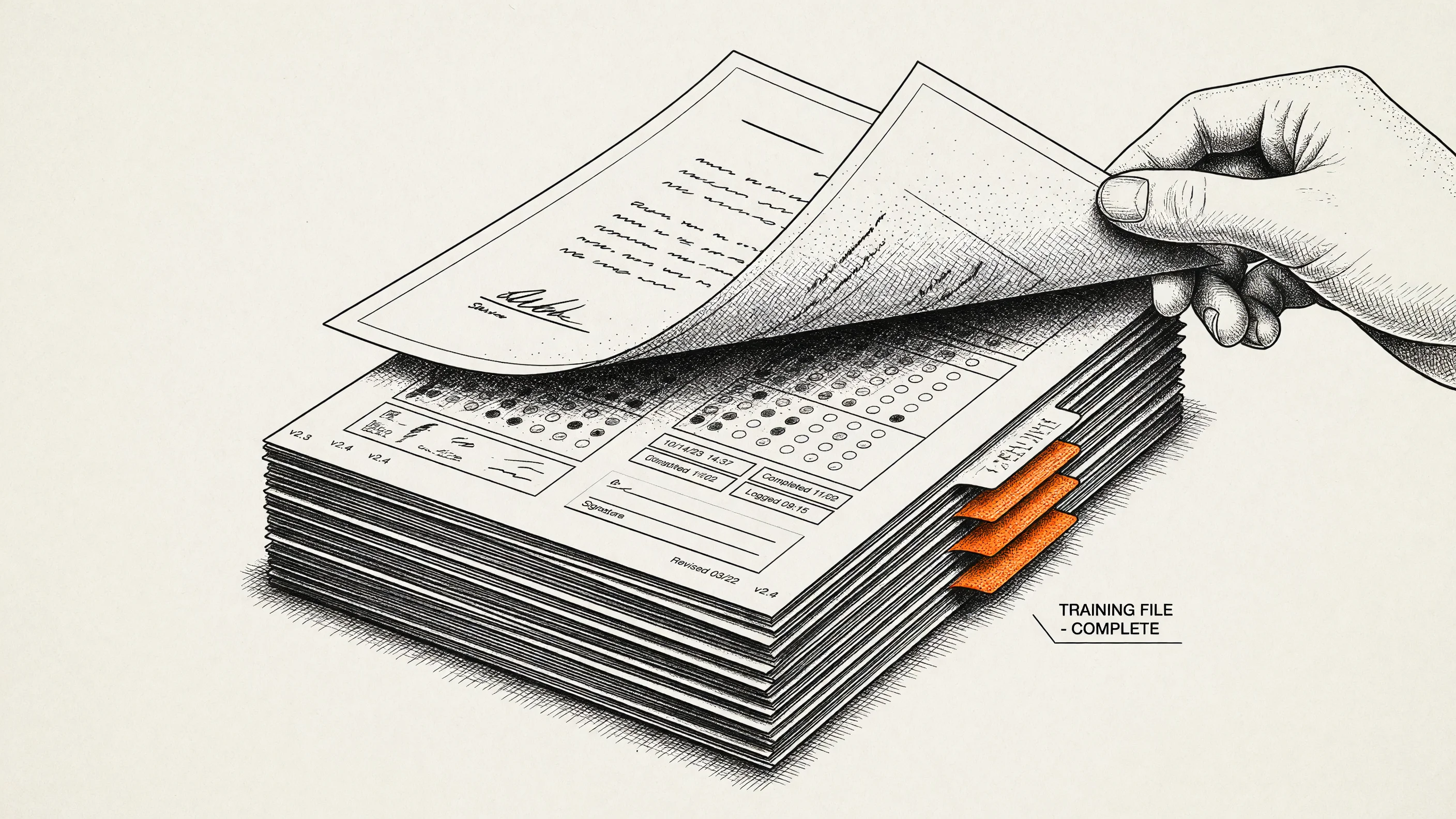
A certificate is a summary. A record is the evidence behind it. For a single lesson or policy, a complete record includes:
- The exact content version the driver saw. Not the current version. The one that was live on the day they took it, word for word.
- The acknowledgment text they agreed to. The specific policy language or attestation the driver signed off on, not just the fact that they clicked something.
- Quiz scores and every attempt. Including failed attempts and retries, not only the final pass. The full picture is more credible than a clean one that hides the retries.
- Signatures, and who signed. An electronic signature tied to the driver, with enough detail to show it was really them.
- Timestamps. When the material was assigned, when the driver started, and when they completed it.
- Certificates. The summary document, backed by everything above.
- Practical and road-test evidence. For hands-on items, the evaluator's name, the result, and any photos or documents captured at the time.
If you have the certificate but not the version, the acknowledgment text, the attempts, and the timestamps behind it, you have a summary of a record you cannot actually produce.
The self-audit checklist
Run this for two or three drivers: one recent hire, one from a year or more ago, and one who has had a corrective-action event. For each driver, can you answer yes to every line, in minutes, without a support call?
- Can you list every lesson, policy, and program the driver was assigned?
- For each item, can you show the exact version of the content they saw at the time?
- Can you produce the acknowledgment text the driver signed, not just the fact that they signed?
- Can you show quiz scores, including every attempt and retry?
- Can you show the timestamps: assigned, started, and completed?
- Can you produce the road-test result and the evaluator's name?
- Can you show any corrective-action training triggered by an event, and its completion?
- Are all of the above tied to one identifiable driver, with nothing mixed up between people with similar names?
- Can you export the whole thing as one organized package to hand to an auditor, insurer, or attorney?
- Could someone other than you produce it if you were on vacation?
Every "no" is a gap. Some gaps are annoying. Some are the kind that get quoted back to you in a deposition.
Why version integrity matters most
There is one gap that is worse than a missing file: a record that changed after the fact.
Say a driver completed a policy in one form. A year later, you edit that policy, and the old version is overwritten everywhere, including in that driver's completed record. Now the record says the driver acknowledged language they never actually saw. You did not do anything dishonest. You just edited a document. But you can no longer prove what the driver truly agreed to, and a record that appears to have been changed after the fact is a liability, not evidence. It undermines the credibility of everything else in the file.
This is why serious recordkeeping treats versioning as sacred. When content is edited, the new version applies only to future assignments. What a driver already completed stays frozen exactly as it was on the day they signed. A record you can trust is one that has never quietly changed underneath you.
Put plainly: an incomplete record is a problem, but an altered record can be worse than no record at all.
What to do if you found gaps
If the self-audit turned up holes, a few practical moves help:
- Standardize where records live so a driver's history is in one place, not spread across binders, spreadsheets, and inboxes.
- Capture the version and the acknowledgment text at the moment of completion, not later.
- Make sure timestamps and attempts are recorded automatically, so they do not depend on someone remembering.
- Lock completed records so editing current content never rewrites a driver's past.
- Export your records on a regular schedule so you are never dependent on a single system or a single person.
You do not need a specific product to do any of this. You need a system that captures the full record automatically and never changes history.
Keep the online training record together
Raisedash keeps the online training information it records under the driver. The current PDF report includes assigned trainings, completion details, quiz attempts and scores, recorded activity, and certificates. It does not replace the carrier's driver qualification file or other required records. If you want to see the report, book a demo.
Before you do, it is worth running the self-audit above on your own files first. It is the fastest way to learn whether your current process would hold up, and it pairs well with a structured 90-day onboarding plan that builds a clean record from a driver's first day.
Frequently Asked Questions
What counts as a complete driver training record?
A complete record is more than a certificate. It includes the exact version of the content the driver saw, the acknowledgment text they signed, quiz scores and every attempt, signatures, timestamps for when material was assigned, started, and completed, road-test and practical evidence, and the certificate that summarizes it. If you have only the certificate, you cannot fully produce the record behind it.
Who can ask a fleet for a driver's training records?
Most commonly safety auditors, insurers and loss-control partners at renewal, and plaintiff attorneys in discovery after a crash. Each asks for different reasons, but all of them want to see exactly what a driver received and proof that the driver engaged with it.
Why does the version of a training document matter?
Because the record needs to reflect what the driver actually saw, not what your content says today. If a document is edited and the old version is overwritten in a driver's completed record, you can no longer prove what they truly acknowledged. A record that appears to have changed after the fact can be worse than no record at all, which is why completed records should be frozen at the version the driver signed.
How long should it take to produce one driver's complete record?
With records captured automatically and stored in one place, it should take seconds to minutes. If producing one driver's full history takes days, or depends on one person and their memory, that is the gap to fix before an auditor, insurer, or attorney finds it.